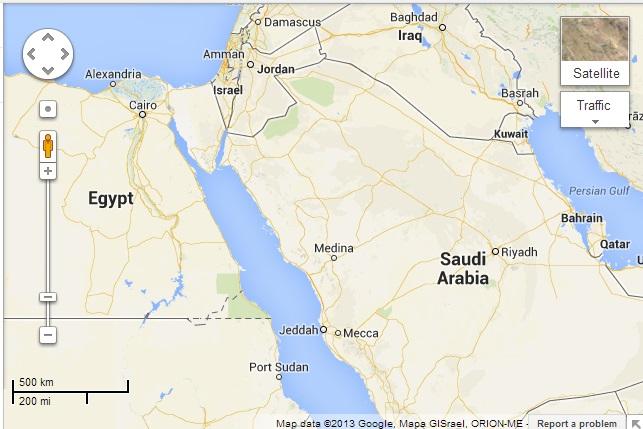
Map of Egypt
Alexandria
Alexandria is the second largest city in Egypt, with a population of 4.1 million, extending about 32 km (20 mi) along the coast of the Mediterranean Sea in the north central part of the country. It is also the largest city lying directly on the Mediterranean coast. Alexandria is Egypt's largest seaport, serving approximately 80% of Egypt's imports and exports. It is an important industrial center because of its natural gas and oil pipelines from Suez. Alexandria is also an important tourist resort.
Alexandria was founded around a small pharaonic town c. 331 BC by Alexander the Great. It became an important centre of the Hellenistic civilization and remained the capital of Hellenistic and Roman & Byzantine Egypt for almost one thousand years until the Muslim conquest of Egypt in AD 641, when a new capital was founded at Fustat (later absorbed into Cairo). Hellenistic Alexandria was best known for the Lighthouse of Alexandria (Pharos), one of the Seven Wonders of the Ancient World; its Great Library (the largest in the ancient world; now replaced by a modern one); and the Necropolis, one of the Seven Wonders of the Middle Ages. Ongoing maritime archaeology in the harbor of Alexandria, which began in 1994, is revealing details of Alexandria both before the arrival of Alexander, when a city named Rhacotis existed there, and during the Ptolemaic dynasty.
From the late 19th century, Alexandria became a major center of the international shipping industry and one of the most important trading centers in the world, both because it profited from the easy overland connection between the Mediterranean Sea and the Red Sea, and the lucrative trade in Egyptian cotton.


Cairo
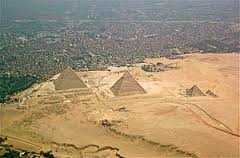
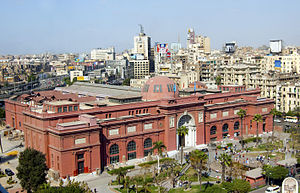
Cairo is the capital of Egypt and the largest city in the Arab world and Africa. Its metropolitan area is the 16th largest in the world. Located near the Nile Delta, it was founded in 969 AD. Nicknamed "the city of a thousand minarets" for its preponderance of Islamic architecture, Cairo has long been a centre of the region's political and cultural life. Cairo was founded by the Fatimid dynasty in the 10th century AD, but the land composing the present-day city was the site of national capitals whose remnants remain visible in parts of Old Cairo. Cairo is also associated with Ancient Egypt as it is close to the ancient cities of Memphis, Giza and Fustat which are near the Great Sphinx and the pyramids of Giza.
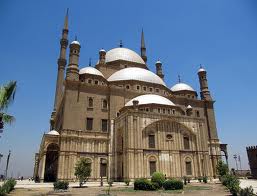
Luxor is a city in Upper (southern) Egypt and the capital of Luxor Governorate. The population numbers 487,896 (2010 estimate), with an area of approximately 416 square kilometres (161 sq mi). As the site of the Ancient Egyptian city of Thebes, Luxor has frequently been characterized as the "world's greatest open air museum", as the ruins of the temple complexes at Karnak and Luxor stand within the modern city. Immediately opposite, across the River Nile, lie the monuments, temples and tombs on the West Bank Necropolis, which include the Valley of the Kings and Valley of the Queens. Thousands of tourists from all around the world arrive annually to visit these monuments, contributing a large part towards the economy for the modern city.
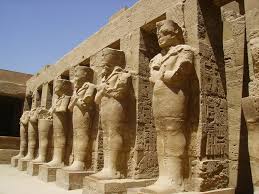
The Karnak Temple Complex, commonly known as Karnak, comprises a vast mix of decayed temples, chapels, pylons, and other buildings. Building at the complex began during the reign of Sesostris I in the Middle Kingdom and continued into the Ptolemaic period, although most of the extant buildings date from the New Kingdom. The area around Karnak was the ancient Egyptian Ipet-isut ("The Most Selected of Places") and the main place of worship of the eighteenth dynasty Theban Triad with the god Amun as its head. It is part of the monumental city of Thebes. The Karnak complex gives its name to the nearby, and partly surrounded, modern village of el-Karnak, 2.5 km north of Luxor.
Aswan, formerly spelled Assuan, is a city in the south of Egypt, the capital of the Aswan Governorate.Aswan is a busy market and tourist centre located just north of the Aswan Dams on the east bank of the Nile at the first cataract. The modern city has expanded and includes the formerly separate community on the island of Elephantine.